

Women’s History Month, established by Congress in 1987, celebrates the achievements of women, often through a narrow lens. Information, actions, and events center around stories of cisgender, white, middle-class women ignoring the contributions of those who may not fit the traditional female narrative. These stories are important, but they aren’t the complete story. Gender equity began as a fight for the rights of well to do white women but expanded over the decades to include women of all races, abilities, gender identities and backgrounds, many of who faced exclusion not only from society but from the movement meant to uplift them.
This month, we have an opportunity to expand our understanding of who is included in “women’s history” and to honor the diverse voices that have shaped the world we live in today.
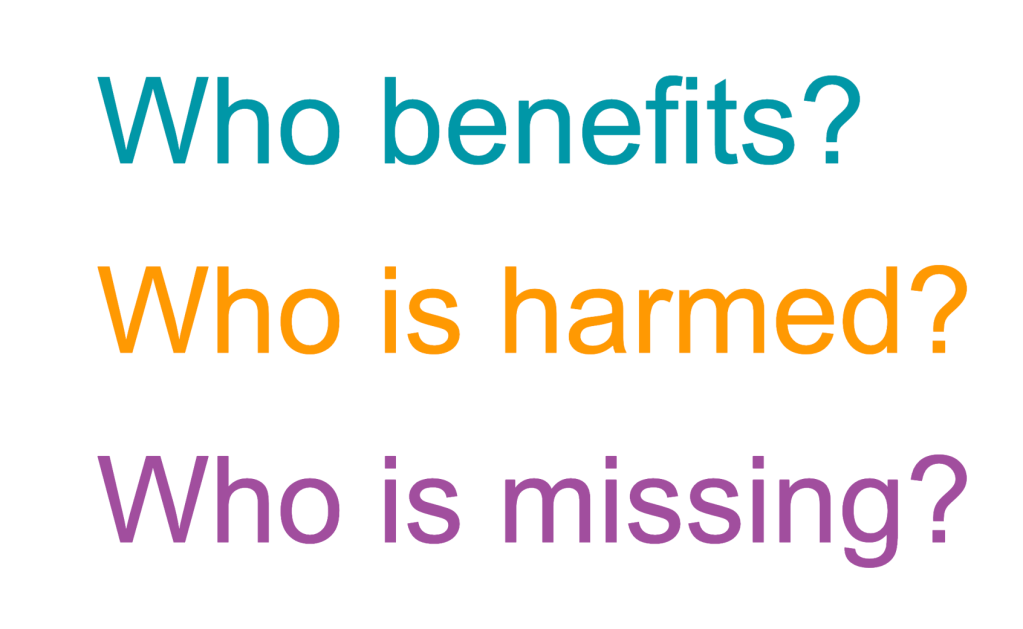
When I introduce equitable design to my students, I task them with answering the questions above when considering a solution to a problem. This approach to design is best explained via the “curb cut effect”. I use the video below with my students; the content is actually directed at teachers and how the design considerations of curb cuts can be applied in our classrooms. It’s a great introduction to design thinking for teachers!
Below is a general activity that can be adapted to your classroom this. month that includes the elements of the three questions above when exploring the evolution of feminism in the United States. Consider the approaches touched on in the video when you plan your lesson!
Who’s Missing? Expanding Feminism for All
In this pair of activities, students explore the evolution of feminism, analyze who has been included, excluded, and harmed by the beliefs and actions of the feminist movement over time, and then research young feminists in order to create a vision of a more inclusive future.
First Activity: “Who’s Missing from Feminism?” (Past & Present Analysis)
Objective: Understand the history of feminism, recognize its gaps, and discuss why inclusive advocacy matters.
Activity: Small Group Research & Presentation
- Assign groups different waves of feminism or key feminist movements (e.g., suffrage, second-wave feminism, modern intersectional feminism).
- Have groups identify who was included and who was left out (e.g., Black women, trans women, Indigenous women, disabled women) and how those who were left out were harmed by the omission.
- Groups present findings with a focus on how exclusion shaped the movement and what lessons can be applied today.
Reflection Questions:
- Why were certain voices excluded?
- How does this exclusion affect the way we understand feminism today?
- How can we ensure movements for gender equity are truly inclusive?
Activity 2: “Future Female Changemakers” (Student-Led Vision & Action)
Objective: Research and amplify the voices of young women shaping the future and develop students’ own advocacy skills.
Activity: Research & Personal Mission Statement
Each student researches a young activist or leader (e.g., Malala Yousafzai, Gitanjali Rao, Raquel Willis, etc.).
They create a “Change Maker Profile” (poster, slide deck, or other product) explaining:
- Who the change maker is.
- What issue they address.
- Why their activism matters.
- What lessons we can learn from them.
Students then write their own mission statement:
- What issues do they care about?
- What steps can they take to make a difference?
- How can they ensure that marginalized groups benefit and no one is harmed in the implementation of their mission statement?
Reflection Questions:
- How can we advocate for inclusion in our own communities?
- What role does their generation play in shaping the future of gender equity?
Taken together, these activities are both critical and hopeful—students learn about past exclusion in tandem with the agency young people have today in implementing change. This sequence could conclude with a presentation to students outside the class or a showcase available to the entire school community.
No matter who your students are or what content you teach, women play a role. This month, make a conscious effort to highlight the contributions of all women and the power students have to impact the lived experiences of the women in our communities and throughout the world.

Women make history every day! Let’s celebrate, uplift, and advocate all year long.

 mcvsddiversity.com